
How Much Caffeine in Green Tea Leaves?
When you brew a cup of green tea, you may wonder how much caffeine is actually inside those delicate leaves. The answer is more complex than a single number. Caffeine levels in tea depend on factors such as the variety of tea, whether the leaves were shaded or roasted, how mature the leaves were at harvest, and even how you prepare your cup. For example, shaded teas like gyokuro and matcha naturally contain more caffeine, while roasted teas like hojicha and twig-based teas like kukicha are much lower (1).
On average, a brewed cup of green tea contains about 20–45 mg of caffeine per 8 oz serving, although some can be as low as 7 mg and others rival coffee with over 100 mg. Matcha, in particular, stands out because you consume the whole powdered leaf rather than just an infusion, making it one of the most caffeinated teas (2).
In this guide, we’ll break down the caffeine content of 14 popular teas—including gyokuro, matcha, sencha, hojicha, kukicha, oolong, and even black teas like Assam and Darjeeling. You’ll see how they compare, what makes some higher or lower, and how to brew them to control your caffeine intake.
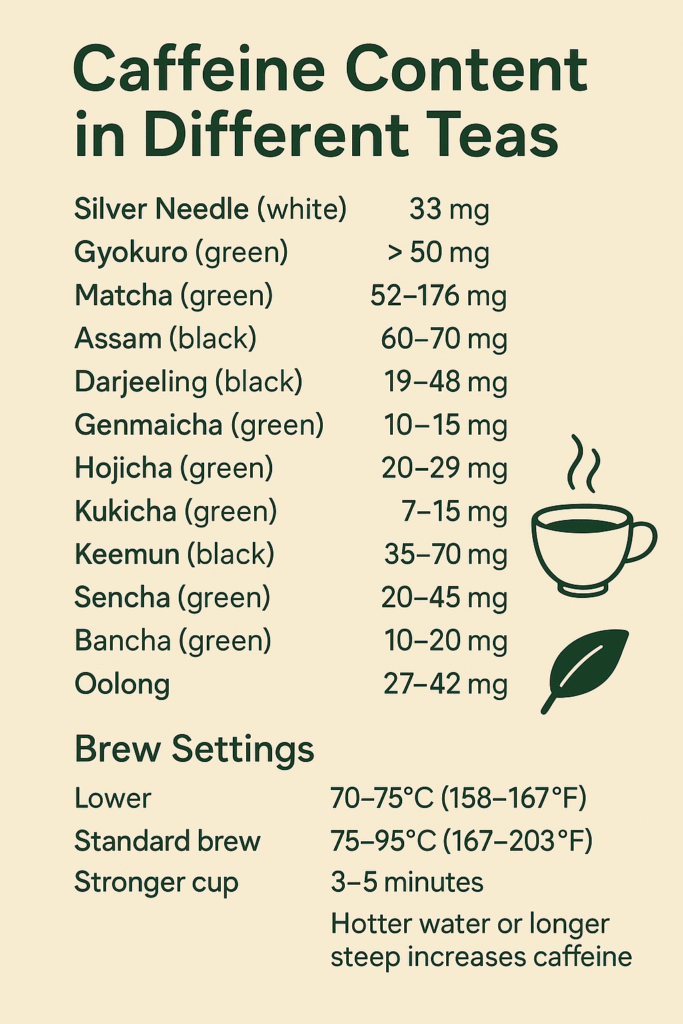
Quick Answer: How Much Caffeine in Tea at a Glance
Most green teas fall in the range of 20–45 mg of caffeine per 8 oz (240 ml) cup. But depending on the type, leaf age, and brewing method, the numbers can swing much higher or lower. For comparison:
- Typical brewed green tea: ~20–45 mg per 8 oz (3)
- Matcha: ~38–176 mg per serving, depending on how much powder is used
- Very low teas like hojicha or kukicha: ~7–15 mg per 8 oz (5)
- Black teas (Assam, Darjeeling, Ceylon): ~40–70 mg per 8 oz (6)
- Oolong teas: typically 30–50 mg per 8 oz
Average Caffeine by Tea Category (per 8 oz brewed cup)
| Tea Category | Typical Caffeine (mg) | Notes |
|---|---|---|
| White (e.g., Silver Needle) | 15–30 | Bud-heavy whites can surprise with higher caffeine |
| Green (most types) | 20–45 | Shaded greens trend higher, roasted greens lower |
| Oolong | 30–50 | Mid-range; varies by oxidation and leaf size |
| Black | 40–70 | Stronger brews like Assam trend high |
| Powdered (Matcha) | 38–176 | Entire leaf consumed; dose depends on grams used |
Safe intake guideline: Most healthy adults can consume up to 400 mg caffeine per day, though pregnant women are advised to limit intake to around 200 mg daily (8).
Master Table: Caffeine by Tea Type
| Tea | Category | Caffeine per 8 oz (mg) | Why Higher or Lower | Notes |
|---|---|---|---|---|
| Gyokuro | Green | 35–65 | Shade-grown leaves concentrate caffeine and theanine | Among the strongest green teas, rich umami flavor |
| Matcha | Green (powder) | 38–176 (per serving) | Whole powdered leaf is consumed, not steeped | A 2 g serving has ~76 mg; often whisked into lattes |
| Sencha | Green | 30–40 | Sun-grown spring leaves, moderate caffeine | Japan’s most common everyday green tea |
| Bancha | Green | 20–30 | Later harvest, mature leaves with less caffeine | Mild flavor, gentle on stomach, family tea |
| Genmaicha | Green + Roasted Rice | 15–20 | Rice dilutes the tea leaf content, lowering caffeine | Nutty flavor, popular evening drink |
| Hojicha | Green (roasted) | 7–15 | Roasting reduces caffeine and bitterness | Smooth, smoky flavor; safe for night drinking |
| Kukicha | Green (twig tea) | 7–15 | Made mostly from stems and twigs, very low caffeine | Among the lowest-caffeine Japanese teas |
| Gunpowder | Green | 30–40 | Rolled pellets release caffeine steadily | Strong, bold flavor; popular in Morocco |
| Oolong | Oolong | 30–50 | Partially oxidized; caffeine varies by style | Tie Guan Yin tends lower, roasted oolongs higher |
| Assam | Black | 50–70 | Robust cultivar, fully oxidized | Often used in breakfast blends, brisk flavor |
| Ceylon | Black | 40–60 | Altitude and harvest influence levels | Medium body, bright citrus notes |
| Darjeeling | Black | 40–50 | First flush lighter, second flush richer | Delicate muscatel flavor, moderate caffeine |
| Keemun | Black | 40–60 | Classic Chinese black, small leaves | Smooth, wine-like flavor, medium caffeine |
| Silver Needle (Baihao Yinzhen) | White | 25–40 | Bud-heavy white teas naturally have higher caffeine | Myth-buster: white tea can match green in caffeine |
Key Takeaways from the Table
- Highest in caffeine: Matcha (whole leaf powder), Gyokuro (shade-grown).
- Lowest in caffeine: Hojicha and Kukicha (roasted or twig-based).
- Middle ground: Sencha, Gunpowder, Oolong.
- Black teas: Assam tends higher; Ceylon, Darjeeling, and Keemun moderate.
- White tea myth: Silver Needle often equals or surpasses some green teas in caffeine.
How We Estimated Caffeine
The caffeine values in the table are averages based on scientific analyses and nutritional databases. Exact numbers vary widely, but these ranges represent what you can expect from a standard 8 oz (240 ml) serving.
Primary References
- Large-scale HPLC analysis of 77 teas published in the Journal of Food Science provided reliable caffeine distribution across white, green, oolong, and black teas.
- Japanese Tea Research confirmed that Japanese greens like sencha, gyokuro, and bancha contain 2–4% caffeine by dry weight.
- Matcha-specific studies reported 19–44 mg caffeine per gram, depending on cultivation and grind.
Brewing Assumptions
- Leaf to water ratio: 2 g of dry leaf per 8 oz (240 ml) of water.
- Water temperature: 75–85 °C for greens, 90–95 °C for oolongs and blacks, 95–100 °C for whites and Assams.
- Steeping time: 2–3 minutes unless otherwise noted.
- Powdered teas: For matcha, values are based on grams consumed directly, not infusion.
Why Numbers Vary
- Cultivar and leaf type: Young buds and shaded leaves contain more caffeine than mature leaves.
- Processing: Shading (gyokuro, matcha) boosts caffeine, while roasting (hojicha) reduces extraction.
- Preparation: Longer steeping, hotter water, and more leaves increase caffeine.
- Leaf form: Whole-leaf powder like matcha delivers the full caffeine content because you ingest the leaf.
Understanding these factors explains why two cups of “green tea” can deliver dramatically different caffeine levels.
Gyokuro (Green Tea)
Gyokuro is one of the highest-caffeine green teas because it is shade-grown for about three weeks before harvest. Shading increases amino acids like L-theanine and also concentrates caffeine in the young leaves.
Caffeine Content (per 8 oz cup)
| Brew | Typical Caffeine (mg) | Notes |
|---|---|---|
| Standard infusion | 35–65 | Among the strongest Japanese greens |
| Strong infusion | 70+ | Hotter water and longer steeping can push higher |
Why so high? Shading increases nitrogen compounds, which boost both caffeine and umami.
Brewing tip: To enjoy gyokuro with less caffeine, brew at lower temperatures (50–60°C / 122–140°F) and shorter steep times. This emphasizes sweetness and umami while minimizing caffeine extraction.
Matcha (Powdered Green Tea)
Matcha stands apart because it is made from powdered shade-grown leaves. Instead of steeping and discarding the leaves, you consume the entire leaf when whisking it into water or milk. This means caffeine intake depends directly on how much powder you use.
Caffeine Content (per serving)
| Serving Size | Typical Caffeine (mg) | Notes |
|---|---|---|
| 1 g powder | 19–44 | Average per gram |
| 2 g serving | 38–88 | Standard thin tea (usucha) |
| 4 g serving | 76–176 | Thick tea (koicha), very strong |
Why so high? Shading plus whole-leaf consumption make matcha one of the most caffeinated teas.
Brewing tip: Use 1–2 g for daily drinking if you want a balance of flavor and manageable caffeine. Reserve larger doses for special occasions. Matcha’s L-theanine helps soften the stimulating effect, creating a calm alertness.
Sencha (Green Tea)
Sencha is Japan’s most common everyday green tea. Unlike gyokuro, it is grown in full sun, which gives it a fresh, grassy taste and moderate caffeine content. It strikes a balance—stronger than bancha or hojicha but lighter than matcha or gyokuro.
Caffeine Content (per 8 oz cup)
| Brew | Typical Caffeine (mg) | Notes |
|---|---|---|
| Standard infusion | 30–40 | Moderate caffeine |
| Strong infusion | 45–55 | Hotter water (85–90°C) and longer steeps extract more |
Why moderate? Sencha is made from young leaves harvested in spring, but because it is not shaded, its caffeine levels are lower than gyokuro.
Brewing tip: Use 75–80°C (167–176°F) water for 1–2 minutes to bring out a smooth flavor and keep caffeine moderate.
Bancha (Green Tea)
Bancha is made from mature leaves harvested later in the season. These leaves naturally contain less caffeine than the younger, tender leaves used for sencha or gyokuro. Bancha is mild, earthy, and often served as a family tea.
Caffeine Content (per 8 oz cup)
| Brew | Typical Caffeine (mg) | Notes |
|---|---|---|
| Standard infusion | 20–30 | Low–moderate |
| Strong infusion | 30–35 | Higher with longer steeping |
Why lower? Older leaves store less caffeine and have more fibrous structure, which limits extraction.
Brewing tip: Use hotter water (80–85°C / 176–185°F) since bancha is more forgiving, and steep 2–3 minutes for a mild but flavorful brew.
Genmaicha (Green Tea with Roasted Rice)
Genmaicha is a blend of green tea (usually sencha or bancha) and roasted brown rice. Because much of the brew comes from the rice, which contains no caffeine, the overall caffeine content is significantly lower than most green teas. Its nutty, toasted flavor makes it popular as a gentle evening tea.
Caffeine Content (per 8 oz cup)
| Brew | Typical Caffeine (mg) | Notes |
|---|---|---|
| Standard infusion | 15–20 | Lower due to rice dilution |
| Strong infusion | 20–25 | If more tea leaf is used than rice |
Why lower? The roasted rice reduces the ratio of tea leaves in the blend, lowering total caffeine.
Brewing tip: Use 80°C (176°F) water for 2 minutes for balance. Steep longer if you prefer a more roasted, nutty flavor without worrying about caffeine spikes.
Hojicha (Roasted Green Tea)
Hojicha is made from sencha, bancha, or kukicha leaves that are roasted at high heat. The roasting process lowers caffeine content and reduces bitterness, making hojicha one of the mildest Japanese teas. Its smooth, smoky, and slightly caramel-like flavor is especially comforting in the evening.
Caffeine Content (per 8 oz cup)
| Brew | Typical Caffeine (mg) | Notes |
|---|---|---|
| Standard infusion | 7–15 | Among the lowest of all green teas |
| Strong infusion | 15–20 | Even then, still very low |
Why so low? Roasting breaks down some caffeine and polyphenols, and hojicha is often made from mature leaves and stems.
Brewing tip: Use 90°C (194°F) water for 30–60 seconds. Hojicha can handle higher temperatures without becoming bitter, but caffeine remains low.
Kukicha (Twig Tea)
Kukicha, also called “twig tea,” is made from the stems, stalks, and twigs of the tea plant rather than primarily the leaves. Since caffeine is concentrated in young leaves and buds, kukicha naturally contains very little caffeine, making it one of the mildest Japanese teas.
Caffeine Content (per 8 oz cup)
| Brew | Typical Caffeine (mg) | Notes |
|---|---|---|
| Standard infusion | 7–15 | Very low due to twig composition |
| Strong infusion | 15–20 | Still mild compared with leaf teas |
Why so low? Stems and twigs have much less caffeine than leaves or buds.
Brewing tip: Use 80–85°C (176–185°F) water for 2–3 minutes. Kukicha is forgiving and rarely becomes bitter, making it suitable for multiple infusions.
Gunpowder (Green Tea)
Gunpowder is a Chinese green tea made from tightly rolled pellets of tea leaves. The rolling process preserves freshness and allows a slow, steady release of caffeine during brewing. Its strong, bold flavor can deliver moderate caffeine levels, often higher than sencha if brewed strong.
Caffeine Content (per 8 oz cup)
| Brew | Typical Caffeine (mg) | Notes |
|---|---|---|
| Standard infusion | 30–40 | Moderate caffeine, comparable to sencha |
| Strong infusion | 45–50 | Higher with hotter water and longer steeping |
Why moderate? Gunpowder is often brewed hotter and longer, which extracts more caffeine than delicate Japanese greens.
Brewing tip: Use 75–80°C (167–176°F) water for 2 minutes for a smoother cup. For traditional Moroccan mint tea, steep longer, but expect higher caffeine levels.
Oolong Tea
Oolong is a partially oxidized tea that falls between green and black tea in flavor and caffeine. The range is wide because some oolongs are lightly oxidized (closer to green) while others are darker and more heavily roasted (closer to black).
Caffeine Content (per 8 oz cup)
| Brew | Typical Caffeine (mg) | Notes |
|---|---|---|
| Standard infusion | 30–50 | Mid-range; lighter oolongs trend lower |
| Strong infusion | 50–60 | Darker or roasted oolongs trend higher |
Why moderate? Processing and oxidation vary widely, which impacts caffeine. Rolled oolongs (like Tie Guan Yin) release caffeine more slowly, while dark roasted oolongs (like Da Hong Pao) can be more robust.
Brewing tip: Use 85–90°C (185–194°F) water, and re-steep multiple times. Later infusions will be lower in caffeine but still flavorful.
Assam (Black Tea)
Assam is a robust Indian black tea known for its bold, malty flavor. It is one of the strongest black teas and is often used in breakfast blends. Because of its cultivar and full oxidation, Assam has some of the highest caffeine levels among black teas.
Caffeine Content (per 8 oz cup)
| Brew | Typical Caffeine (mg) | Notes |
|---|---|---|
| Standard infusion | 50–70 | Higher than most green or oolong teas |
| Strong infusion | 70–90 | Very strong when brewed hot and long |
Why higher? The Camellia sinensis var. assamica variety has naturally higher caffeine levels than the Chinese sinensis variety. Full oxidation during processing also contributes to its strength.
Brewing tip: Use 90–95°C (194–203°F) water for 3–5 minutes. Shorter steeps yield a smoother, less caffeinated brew.
Ceylon (Black Tea)
Ceylon tea, grown in Sri Lanka, has a brisk and citrusy flavor profile. Caffeine levels can vary depending on the altitude and style of production, but overall it sits in the mid-to-high range for black teas.
Caffeine Content (per 8 oz cup)
| Brew | Typical Caffeine (mg) | Notes |
|---|---|---|
| Standard infusion | 40–60 | Average black tea range |
| Strong infusion | 60–70 | Higher with hotter water and longer steeping |
Why moderate to high? Ceylon teas are made from fully oxidized leaves, which generally extract more caffeine than green teas. Teas grown at higher altitudes may contain slightly less caffeine, while lower-altitude teas often brew stronger.
Brewing tip: Use 90–95°C (194–203°F) water for 3–4 minutes. For a lighter cup with less caffeine, steep for 2 minutes.
Darjeeling (Black Tea)
Darjeeling tea, grown in India’s Himalayan foothills, is known as the “champagne of teas” due to its delicate muscatel flavor. Its caffeine levels depend on the harvest: first flush (spring) tends to be lighter, while second flush (summer) brews stronger.
Caffeine Content (per 8 oz cup)
| Brew | Typical Caffeine (mg) | Notes |
|---|---|---|
| Standard infusion | 40–50 | Moderate compared with other black teas |
| Strong infusion | 50–60 | Second flush and longer steeps yield more caffeine |
Why moderate? Darjeeling uses the Chinese sinensis variety, which has lower caffeine than Assam’s assamica. Its partial oxidation (some first flush teas are closer to oolong) also influences caffeine levels.
Brewing tip: Use 85–90°C (185–194°F) water for 2–3 minutes to highlight its floral notes. Longer steeps increase both bitterness and caffeine.
Keemun (Black Tea)
Keemun is a famous Chinese black tea with a smooth, wine-like flavor and floral aroma. It contains moderate caffeine, sitting in the middle of the black tea spectrum.
Caffeine Content (per 8 oz cup)
| Brew | Typical Caffeine (mg) | Notes |
|---|---|---|
| Standard infusion | 40–60 | Mid-range compared to Assam or Darjeeling |
| Strong infusion | 60–70 | Higher with longer steeping times |
Why moderate? Keemun uses the Chinese Camellia sinensis sinensis variety, which generally has less caffeine than the assamica variety used in Assam teas.
Brewing tip: Use 85–90°C (185–194°F) water for 3–4 minutes. Keemun can be re-steeped multiple times, with each infusion delivering less caffeine.
Silver Needle (White Tea)
Silver Needle, or Baihao Yinzhen, is a delicate white tea made only from young buds covered in fine silvery hairs. While many assume white teas have the least caffeine, Silver Needle can actually match or exceed some green teas because young buds are naturally caffeine-rich.
Caffeine Content (per 8 oz cup)
| Brew | Typical Caffeine (mg) | Notes |
|---|---|---|
| Standard infusion | 25–40 | Comparable to sencha or light oolongs |
| Strong infusion | 40–55 | Higher when steeped longer or hotter |
Why moderate? Since Silver Needle is composed entirely of buds, which are caffeine-dense, its levels can be higher than leaf-based teas like bancha.
Brewing tip: Use 75–80°C (167–176°F) water for 2–3 minutes. This preserves its delicate floral flavor while avoiding excess caffeine extraction.
Brew Settings to Dial Caffeine Up or Down
How you brew your tea plays a major role in how much caffeine ends up in your cup. Hotter water, longer steeping times, and more tea leaves all raise caffeine extraction. Cooler water, shorter steeps, and fewer leaves reduce it.
General Guidelines
| Goal | Leaf Amount (per 8 oz) | Water Temp | Steep Time | Result |
|---|---|---|---|---|
| Lower caffeine | 1.5 g | 70–75°C (158–167°F) | 1–2 minutes | Gentle flavor, minimal caffeine |
| Standard brew | 2 g | 75–85°C (167–185°F) | 2–3 minutes | Balanced flavor and caffeine |
| Stronger cup | 2.5–3 g | 85–95°C (185–203°F) | 3–5 minutes | Higher caffeine and more bitterness |
Tips for Managing Caffeine
- Rinse the leaves: Pour hot water over the leaves, discard after 30 seconds, then re-steep. This can reduce caffeine in the next infusion.
- Multiple infusions: The first steep has the most caffeine. Later brews release less.
- Choose roasted or twig teas: Hojicha and kukicha naturally contain less caffeine.
- Powdered teas (Matcha): Control caffeine by adjusting how many grams of powder you whisk.
By mastering your brew method, you can enjoy your favorite tea’s flavor while tailoring caffeine levels to your preference.
Safety and Timing
Caffeine in tea is generally safe for most people, but it’s important to know your limits and adjust based on your health and lifestyle.
Daily Safe Intake
- Most healthy adults: up to 400 mg of caffeine per day from all sources is considered safe (1).
- Pregnant or breastfeeding women: recommended limit is about 200 mg per day to reduce risks to the baby (2).
- Children and teens: caffeine tolerance is lower; small amounts from low-caffeine teas like hojicha or kukicha may be safe but should be monitored.
Timing Matters
- Stop caffeine 6–8 hours before bed if you are sensitive to sleep disruption. Even low-caffeine teas can interfere if consumed late.
- Consider switching to roasted teas (hojicha, genmaicha) or herbal infusions in the evening.
Health Considerations
- Iron absorption: Tannins in tea can reduce absorption of non-heme iron from plant foods. Drink tea between meals, not with iron-rich dishes.
- Stomach sensitivity: Strong teas, especially when brewed hot and long, can irritate the stomach. Roasted or later-harvest teas (bancha, hojicha) are gentler.
- Medical conditions: People with heart issues, anxiety disorders, or caffeine sensitivity should moderate tea intake.
For most tea drinkers, moderate consumption is both safe and beneficial. Understanding how much caffeine is in different teas—and how to brew them—helps you enjoy tea responsibly.
Frequently Asked Questions
Yes, cold brewing extracts caffeine more slowly, so cold-brewed tea generally contains 30–50% less caffeine than hot-brewed tea of the same type
Among green teas, matcha and gyokuro top the list. Matcha can deliver up to 176 mg per serving depending on how much powder you use. Among black teas, Assam is typically the strongest.
Hojicha and kukicha are among the lowest, usually around 7–15 mg per cup. Genmaicha is also low because of its rice content.
Yes. Most caffeine is released during the first steep. By the second and third infusions, caffeine levels are much lower, though flavor compounds remain.
No. This is a myth. Silver Needle (white) can actually match or exceed some green teas because young buds are naturally caffeine-rich
A standard 8 oz cup of brewed coffee has 95–120 mg of caffeine, while most green teas range from 20–45 mg. Matcha, however, can approach or exceed coffee levels depending on the serving size
Small amounts of low-caffeine teas like hojicha or kukicha are sometimes given to children in Japan. However, parents should limit intake and avoid high-caffeine teas like matcha.
Conclusion
The amount of caffeine in green tea leaves varies widely, influenced by the type of tea, how it was grown, and how you prepare it. Shaded teas like gyokuro and matcha can be as strong as coffee, while roasted or twig-based teas such as hojicha and kukicha are naturally low in caffeine. Most green teas, including sencha and gunpowder, sit comfortably in the middle, making them energizing but gentler than black teas.
Brewing choices also matter: hotter water, longer steeping times, and more leaves increase caffeine, while cooler water and shorter infusions help reduce it. Powdered teas like matcha are unique because you consume the whole leaf, leading to significantly higher caffeine levels per serving.
For most adults, drinking tea within the safe daily limit of 400 mg of caffeine can be part of a healthy routine. Choosing the right type of tea for the time of day—low-caffeine teas in the evening, higher-caffeine teas in the morning—can help you enjoy tea without disrupting your sleep or balance.
Ultimately, tea offers not just caffeine but also antioxidants, minerals, and calming compounds like L-theanine, making it a healthier alternative to many caffeinated drinks. By understanding the caffeine content in different teas, you can select the right one to match your taste, energy needs, and lifestyle.


